An oil painting experiment: How long will 'Nightfall' last?
In this post, I explain why I decided to paint on an unprimed canvas.
David D. Haynes
2/26/20253 min read
By David D. Haynes
(First published on Substack)
daviddhaynesart.substack.com
Good morning!
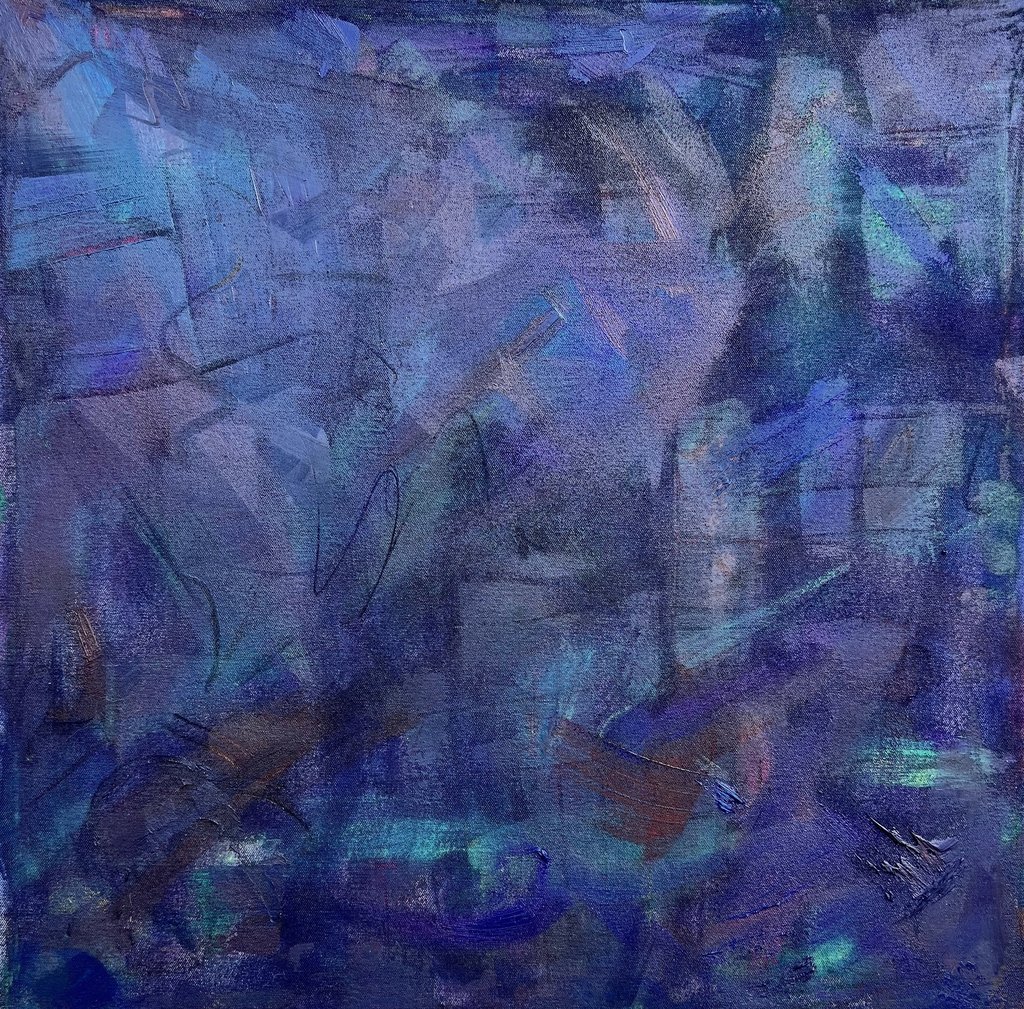
Over the past couple of weeks, I’ve been working on a series of abstract paintings named after the parts of the day - “Daybreak,” “Midday,” and “Nightfall.” The series is titled “24 Hours in the Inferno,” a reference to the time it took poor Dante to journey through hell.
Given the times, I’ll let you draw your own conclusions.
I began painting these pictures in a thin wash of oil paint and mineral spirits the consistency of watercolor then layered on thicker paint. I didn’t prime the canvas. It was just raw cloth, paint, and me. More on that decision in a moment.
I applied this very loose paint with a three-inch brush from a hardware store, soaking the bristles with the wash and slathering it on the canvas until the cloth was soaked through. I blended in additional layers of thinned paint in harmonious colors. Then I squeezed paint directly from the tube, spread it with a putty knife and scraped it off. I squeezed more paint onto the canvas and scraped again. Repeat. Repeat. Repeat. Eventually, after about three hours a painting emerged. “Nightfall” had arrived. I repeated the process with its companions.
Not ready for prime time
But, I may have committed a cardinal sin. It’s well known that oil paint will degrade an unprimed canvas. How long that takes is a matter of opinion, dependent on a host of factors. Maybe I have 20 years - maybe 5. Who knows?
I could argue that this was my intention all along - an artistic comment on the ephemeral nature of life! To paraphrase “Mission Impossible” … this painting will self-destruct in …
The lesson here is that if you want oil paintings to hold up over time, make sure the canvases are properly prepared before the oil touches them. I suspect I’ll do that next time.
I was thinking about this recently when I encountered the great abstract artist Helen Frankenthaler at the Milwaukee Art Museum. Frankenthaler’s “Hotel Cro-Magnon” (1958) and other of her works are part of the museum’s Bradley collection.
Frankenthaler, an admirer of Jackson Pollock’s work, is regarded as a bridge from abstract expressionism to color field painting. She created something new in art in the early 1950s when she thinned oil paint to the consistency of water and poured the mix onto unprimed canvas laid flat on the floor. It was like using watercolor on paper. It was taking Pollock a step further.
Her breakthrough 1952 painting, “Mountains and Sea,” a picture awash in translucent color, was painted using her soak-stain technique and was immediately influential. She used a primer in her later works, such as “Hotel Cro-Magnon,” according to information on the Helen Frankenthaler Foundation website.
In the early 1960s, Frankenthaler switched to acrylics, which don’t pose the same risks to canvas and have other properties she seemed to have valued.
I admire Frankenthaler’s gorgeous paintings - and her grit. It wasn’t easy to be a female painter working in the testosterone-heavy abstract expressionist scene in 1950s New York. Those were the days of Pollock, Willem de Kooning, the writer Jack Kerouac, the poet Alan Ginsberg, jazz greats John Coltrane, Miles Davis, and Dave Brubeck. Women were frequently dismissed by the boys.
Barnett Newman, an abstract expressionist known for his “zips,” apparently was annoyed that Frankenthaler was included in an Esquire article. He wrote this to her in 1957:
It is time that you learned that cunning is not yet art, even when the hand that moves under the faded brushwork so limply in its attempt to make art, is so deft at the artful.
As Adam Gopnik reported in his 2021 New Yorker article, even Joan Mitchell, another noted female artist of the period, went after Frankenthaler, calling her a “Kotex painter,” a coarse reference to her staining technique.
Frankenthaler painted well into the 2000s, including her wonderfully color laden “Warming Trend” in 2002. She worked across many media and forms including sculpture, tapestry and printmaking. Helen Frankenthaler died in 2011.
I suppose we all want anything we create to last. But the thing is: Our days are numbered. Perhaps, our works only need to outlive us.
“There are no rules ... that is how art is born, that is how breakthroughs happen,” Frankenthaler once said. “Go against the rules or ignore the rules, that is what invention is about.”
More on Helen Frankenthaler (and a primer on primers):
New Yorker article (subscription may be required)
Helen Frankenthaler Foundation in New York
Helen’s “Cro-Magnon Hotel” at the Milwaukee Art Museum